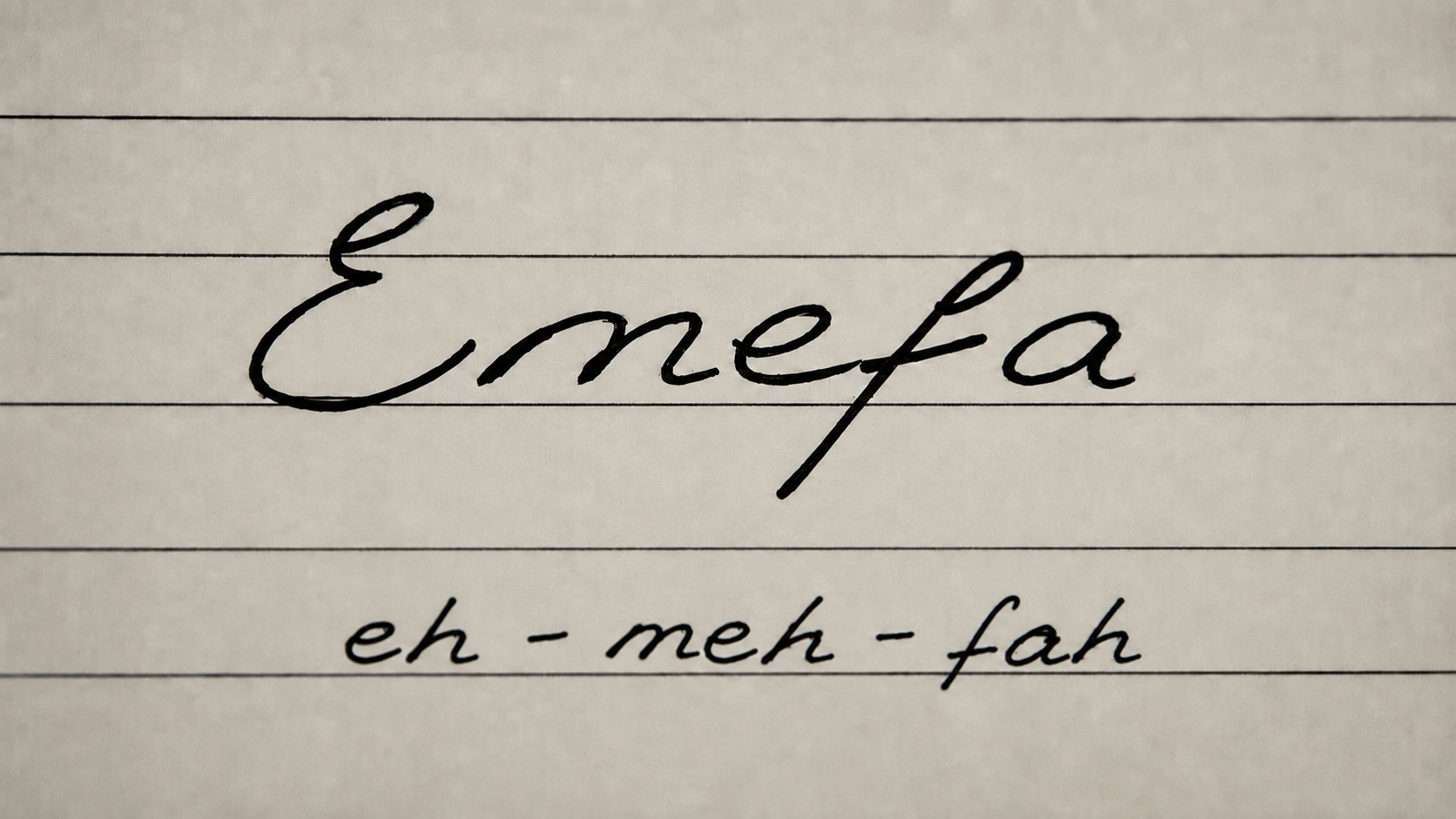
I did not grow up thinking my name was difficult. Other people taught me to.
Away from Ghana, my name began to change shape in other people’s mouths. A teacher would pause at the register, hover over the letters and make a small performance of defeat. I would correct them. Emefa. Em-meh-fah. Three clean beats. Still, I was made to feel as though the correction itself was the problem. I was “extra”. I had “an attitude”. I was not simply asking to be called by my name. I was disturbing the peace of the room.
My name is not a burden; it is Ewe. It loosely translates as “there is peace within”. I have always loved that. It makes my name feel less like a label and more like an affirmation. Each time someone says it properly, they are not only identifying me. They are speaking something over me or even over themselves.
That is why every casual “Can I call you Em?” has always carried weight.
This year’s Africa Day made me think not only about what it means to be African, but about the small acts of recognition so often withheld from Africans by those who encounter us from the outside, beginning with our names.
Names are among the earliest gifts we receive. Before we can speak for ourselves, before we have a profession, a voice, a chosen style or formed a sense of self, we have a name. It is how we are called, introduced, remembered and received. It is our first form of identity. In many African families, a name can carry hope, prayer, history, and a belief about who we might become. So when a name is shortened for convenience, the change is not only linguistic. It changes the terms on which a person is expected to appear.
Later, in professional spaces, the shortening arrived dressed as politeness. “Do you mind if I call you Em?” A question, technically, but the kind of question that already understands the social cost of refusal. To say, “Actually, I do mind,” risks making you seem difficult or ungracious, as though you are rejecting a kindness rather than objecting to an erasure. The burden shifts quietly, and you are expected to absorb the discomfort.
This is the strange theatre many Africans with culturally rooted names must navigate in spaces where meaning is mistaken for difficulty. Our names are treated as tongue-twisters and administrative problems to be solved.
Across the continent, African naming traditions are far too diverse to be folded into one neat system. The Akan day-name is not the same as the Yoruba oríkì, the Igbo name that may unfold like a sentence, the Shona name that may comment on family history, or the isiZulu name that can read like a declaration. Yet beneath this vast linguistic landscape runs a shared reverence for the name not as a passive label, but as a living dialogue between person, family, history and community.
Among Ewe communities in Ghana, Togo, and Benin, a name can speak to the day a child was born, the conditions surrounding their arrival, the family’s hope, their relationship to God or their place in a lineage. In Ewe outdooring ceremonies, where practised in their traditional form, a child may be brought formally into the community on the eighth day. Naming is part of how the child is received.
That context matters because it changes the stakes. When a name like Emefa is reduced to a convenient syllable, what is being shortened is not only sound but its meaning. “There is peace within” becomes “Em”; a sentence becomes a fragment. What was given with intention is reduced for ease.
Anyone who has lived between cultures knows the fatigue of spelling, repeating, correcting and explaining. Sometimes you choose the easier version because you are tired. Sometimes you choose it because you want the interview, the tenancy, the smooth introduction, the child spared from roll-call dread. That choice is not always a rejection of self. Sometimes it is the calculation required to move through spaces that have not made room for the full version of you.
The issue is not that some names are harder than others; it is that difficulty is not judged equally. The actress Uzo Aduba captured this clearly when she recalled asking her mother if she could be called Zoe because people struggled with Uzoamaka. Her mother replied: “If they can learn to say Tchaikovsky and Michelangelo and Dostoyevsky, then they can learn to say Uzoamaka.”
This resonated with me because it names the double standard without over-explaining it. People learn what they believe is worth learning.
Studies on hiring discrimination have shown that names can shape how applicants are judged before they enter the room. Research on résumé whitening has also found that some Black and Asian applicants alter names or remove ethnic markers to avoid discrimination. The name arrives before the body does. It is read, sorted and judged before the person has spoken.
When people tell me the shortened version of my name is “easier”, I want to ask: easier for whom? Ease is not innocent when it always travels in one direction.
I don’t want to tell a simple story of villains. Many mispronunciations are not malicious. Some people are anxious about getting it wrong. Some ask with genuine care. There is patience in teaching someone how to say your name correctly, but there is also a point at which patience becomes a tax. You become a pronunciation guide, cultural ambassador, or mood manager. That tax is paid in tiny instalments. An awkward laugh when someone mangles your name. A “don’t worry” when you do worry. A nickname accepted because the room has made refusal feel rude. A pause before correcting someone senior. A part of yourself is reduced for everyone else’s comfort.
A name is not a problem to be solved. It is not an inconvenience with syllables. It is not something to be made palatable before it is treated with respect.
My name is Emefa. You may need to ask twice. You may need to practise. You may get it wrong before you get it right. That is fine. Perfection has never been the point. Care is.
When I insist on Emefa, I am not insisting on difficulty. I am refusing disappearance.I am asking to be met where respect should begin: at the sound of my name.